































Ecommerce Marketplace Development for Multi-Vendor Platforms
Webority builds the machinery a marketplace actually runs on: vendor onboarding that sellers finish, catalogue and pricing control split correctly between platform and seller, commission rules that match how you really charge, split settlement and payouts a seller can reconcile, and the trust mechanics that keep both sides coming back. You own the platform, the data and the take rate. Engineered under CMMI Level 5 and ISO 27001, from our Delhi NCR centre for operators across India, the US, the UK and the Gulf.
Get a Free Consultation
Fill in your details, and we will respond within 24 hoursTrusted by Leading Brands & Growing Startups









What Marketplace Development Actually Means
A marketplace is not a store with more products in it. You are running a two-sided business: a buying experience on one side, a selling business on the other, and between them the machinery that decides who gets paid what and when. The storefront is the part you demo. The parts that decide whether it survives are onboarding, order splitting across sellers, settlement, and the dispute handling that determines whether either side comes back.
Most people who want a marketplace should not build one yet, and it is worth saying plainly: the hard part is supply, not software. Sellers will not join a platform with no buyers, buyers will not come to a platform with no selection, and no amount of engineering resolves that. This page is for the case where supply is already coming to you and the platform is now the constraint.
Why a Marketplace Is a Different Build
Six things that are true of a marketplace and not of a store. Every one of them changes the architecture, and the teams that discover them late are the ones who built a shop and then tried to bolt sellers onto it.






You Are Building Two Products at Once
A buyer wants selection, trust and a fast checkout. A seller wants reach, a workable back office and money arriving predictably. Those are different products with different success measures, and they compete for the same roadmap. Teams that treat the seller side as an admin panel bolted on afterwards find that sellers quietly stop listing, which removes the selection the buyers came for.
Onboarding Is Where Supply Leaks Away
Every seller you persuaded to sign up still has to finish signing up: documents, bank details, verification, then a catalogue to load before they earn anything at all. Each of those is a place to abandon, and a seller who abandons rarely returns. Onboarding deserves to be designed as a funnel with drop-off measured at every step, not built as a form because it looked like one.
The Take Rate Is the Whole Business Model
Commission is not a setting, it is what you sell. In practice it differs by category, by seller tier, by negotiated agreement, and it moves during promotions and introductory periods. If the platform cannot express that, the real rates end up in a spreadsheet and the number you are actually earning per order becomes something you reconstruct at month end rather than something you can see.
One Payment, Several Recipients
A basket spanning three sellers is one charge to the buyer and three obligations to pay out, each with its own commission, its own tax treatment and its own payout schedule. Then a refund arrives after a payout has already gone. Settlement is the least glamorous part of a marketplace and the one that most reliably decides whether sellers stay, because getting paid late or unexplainably is the fastest way to lose them.
Trust Is Infrastructure, Not a Feature
You are asking a buyer to pay a stranger. Verification, ratings that resist manipulation, seller performance tracking, and a dispute path with a clear decision all carry that weight. A marketplace with weak trust mechanics does not fail loudly, it degrades: the good sellers leave first because they are the ones with somewhere else to go.
Scale Arrives From the Seller Side
The scaling problems are not the ones people plan for. Relevance across thousands of independently-maintained listings is a search problem long before traffic is an infrastructure one. Settlement workload grows with sellers rather than with orders. And admin tooling that was comfortable at fifty vendors becomes unusable at five thousand, which is an interface failure rather than a capacity one.
Core Modules of a Multi-Vendor Marketplace
Six connected modules, of which only the first is the marketplace your buyers ever see.
- 01 Buyer Storefront & Search
- 02 Vendor Onboarding & KYC
- 03 Seller Portal & Catalogue
- 04 Commission & Settlement
- 05 Trust, Ratings & Disputes
- 06 Operator Admin & Analytics






The Marketplace Engineering
Six problems that only exist because there is more than one seller. None of them appears in a demo with three test vendors, and every one of them is where marketplace builds come apart.

Vendor Control Boundaries
What a seller may change freely, what needs approval and what the platform governs outright, decided deliberately rather than discovered when the catalogue starts degrading.

Cross-Catalogue Relevance
Search that works across thousands of listings written by people with different naming habits, which is the real scaling problem on a marketplace long before traffic is.

Order Splitting
One basket becoming several orders with different sellers, shipping, lead times and cancellation paths, while still reading to the buyer as a single purchase they can track.

Commission Rules Engine
Rates by category, tier and agreement with promotional periods, evaluated per order so your take rate is a number you can see rather than one you reconstruct.

Vendor-Count Scaling
Architecture and admin tooling sized for the seller count you are heading toward, because settlement workload and moderation load grow with vendors, not with orders.

Unit Economics Per Seller
Contribution by seller cohort and category, so you can see which supply is worth acquiring and which is costing you more in support than it returns in commission.
Our Journey Of Making Great Things
Numbers that reflect over a decade of consistent delivery, trusted partnerships, and engineering excellence.
Years of experience
Projects delivered
Clients served
Countries reached
Our Success Stories
Every case study below is a product in production, built across healthcare, fintech, government, and e-commerce, and measured by the outcomes it delivers.
Field Inspection App - BRRF
Challenge
Big Red Rooster Flow's paper-based inspections across 500+ gas stations for Exxon, Marathon, 7-Eleven, Gulf, and BP suffered from 42% data error rates, 60-minute inspection times, and zero location verification, causing $4.2M in annual losses and threatening $18M in contracts.
Solution
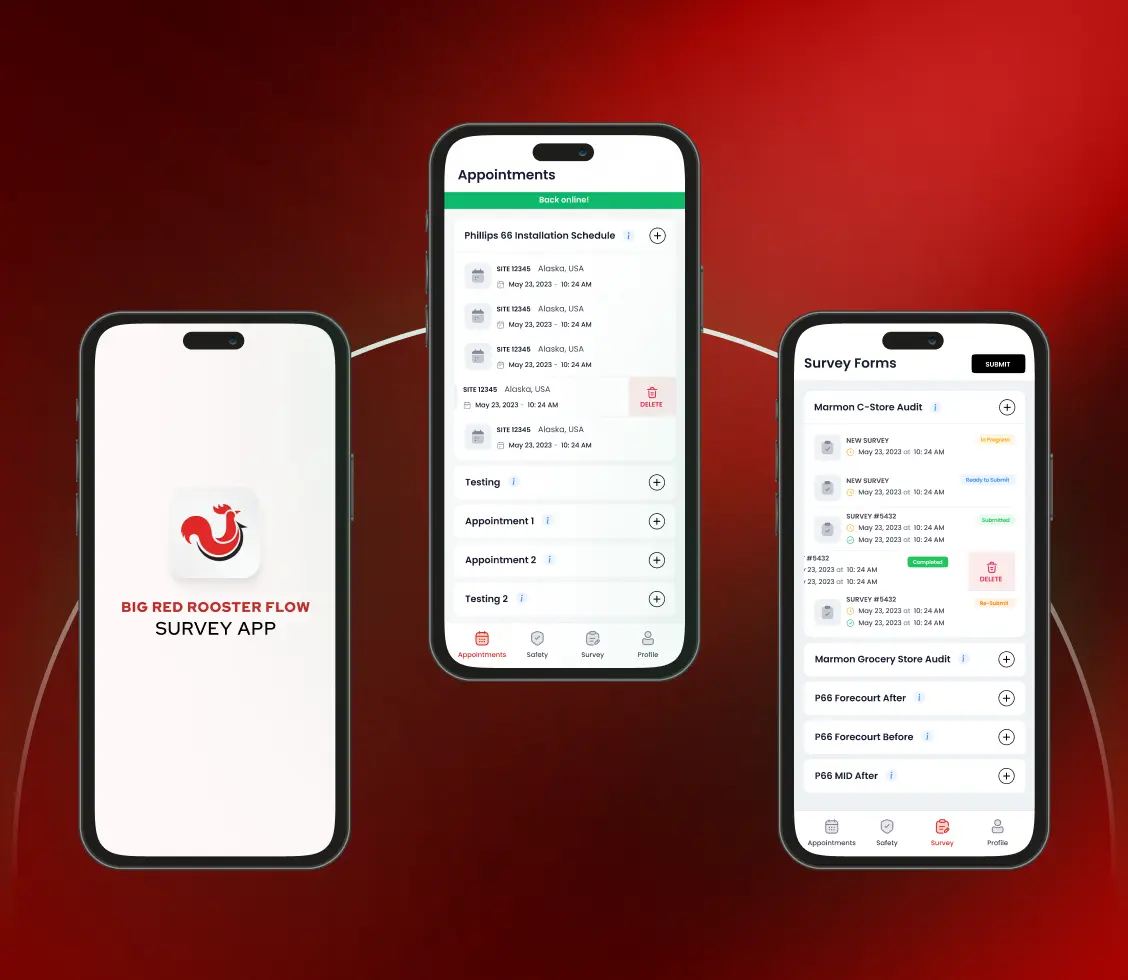
We built a mobile-first survey platform with a no-code visual form builder, intelligent brand-specific survey logic, 99.3% accurate geofencing, full offline capability for 30+ days, a real-time operations dashboard with automated reporting, and role-based access for admins and field teams, deployed across 850+ field inspectors nationwide.
Impact
Energy Star Label Compliance App - BEE
Challenge
Manual inspection of Energy Star labels across India's vast appliance market was slow, error-prone, and lacked centralised visibility, making it difficult for BEE to enforce compliance or for consumers to verify appliance ratings.
Solution
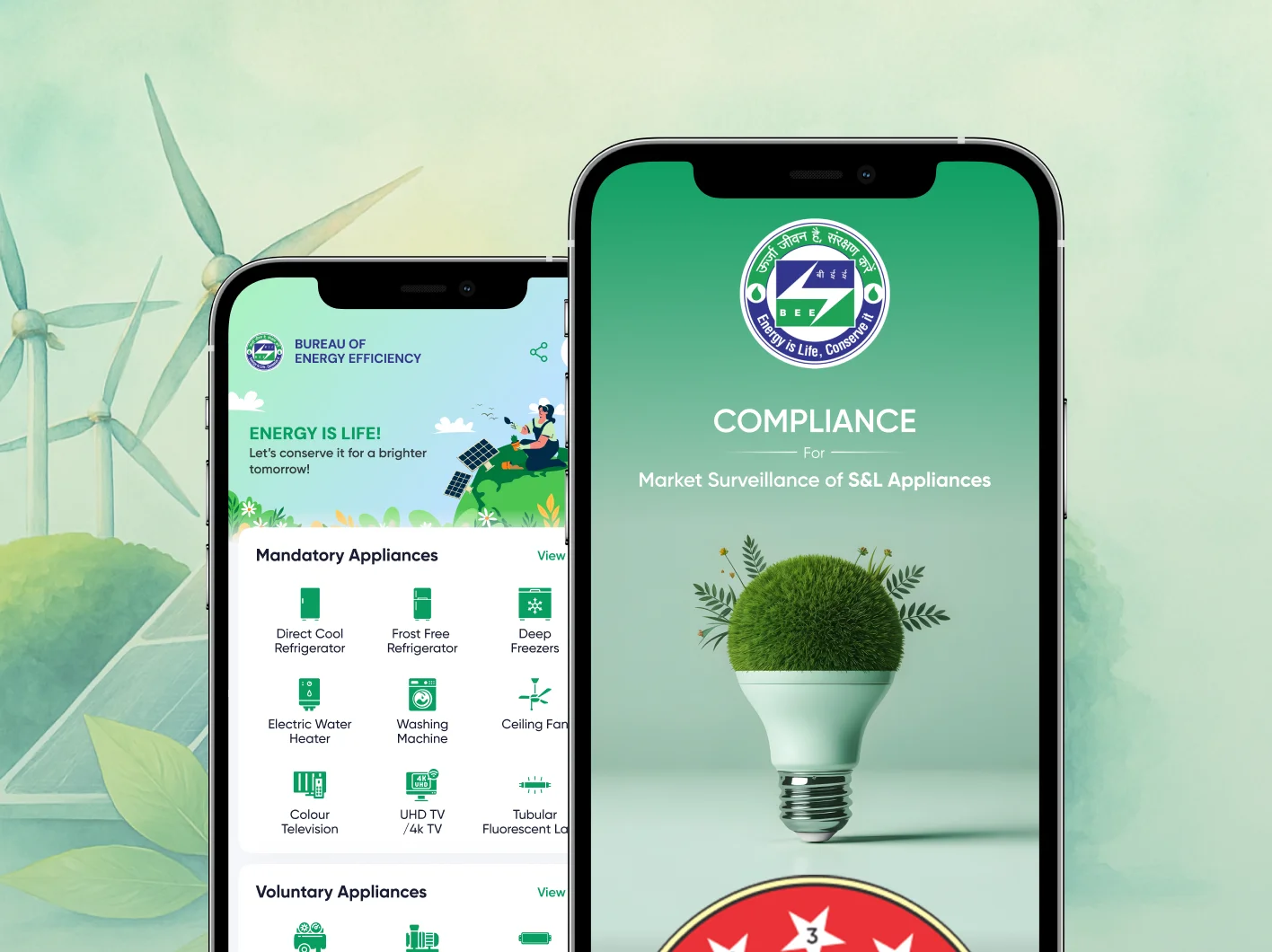
We built a mobile and web platform that enables surveyors to validate star ratings, capture geo-tagged data with photo evidence, work offline, and generate instant reports, while giving consumers a simple interface to browse certified appliances, verify authenticity through star-label lookup, and raise complaints directly to BEE.
Impact

Cafeteria & Food Ordering App - Parliament of India
Challenge
Food ordering within the Indian Parliament relied on traditional, manual processes, leading to long wait times, operational inefficiency, and logistical challenges in managing catering across a high-security environment.
Solution
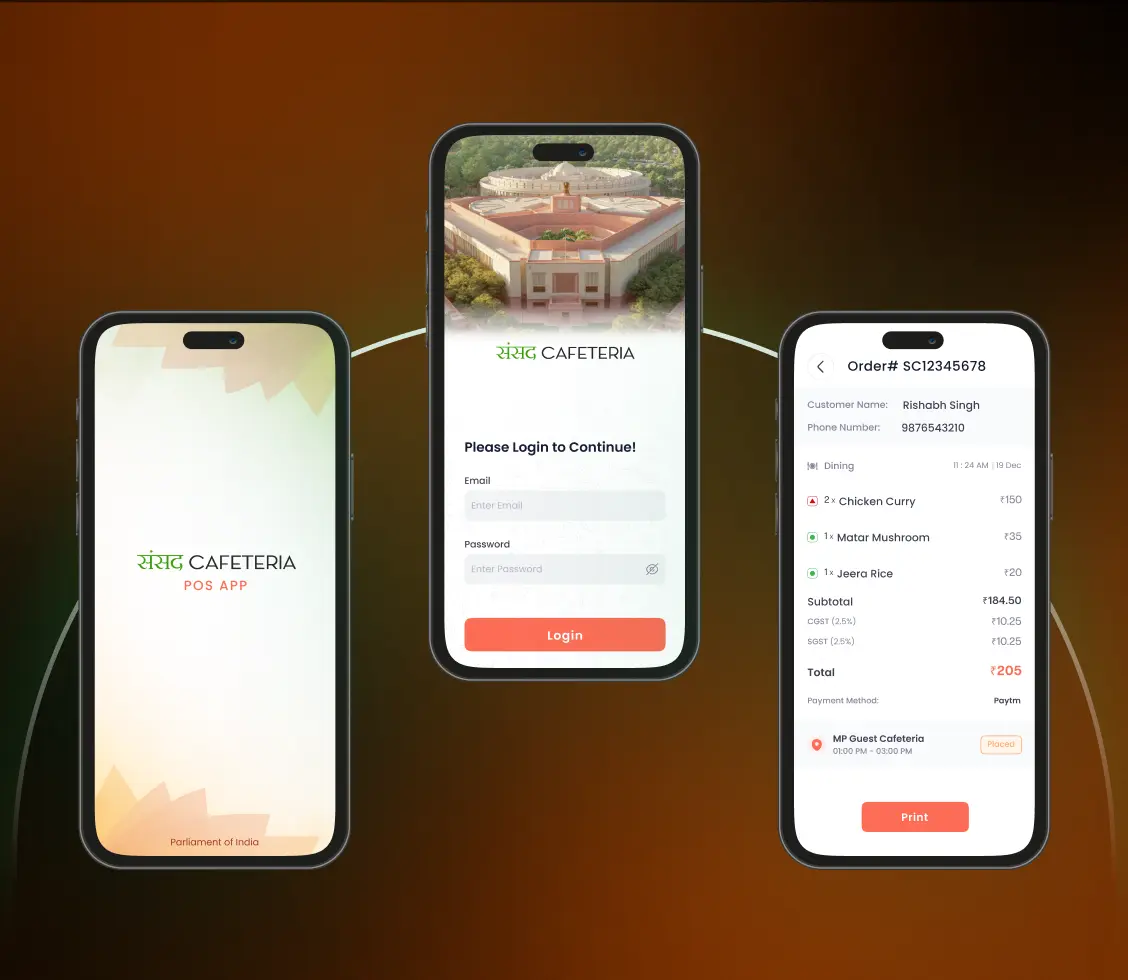
We developed a mobile app for MPs and staff with real-time menu access, QR-based pickup, in-room delivery, integrated digital payments, and full order history, along with an admin portal for ITDC to manage live orders, menus, pricing, user roles, inventory, and reporting across Parliament canteen operations.
Impact
Mental Health Consultation & Booking App - Telepsych
Challenge
Fragmented booking systems and limited online options made accessing mental health consultations difficult for patients, while doctors and admins struggled with manual scheduling.
Solution
We built Telepsych, a web and mobile platform for booking online (Zoom) and in-person consultations, with secure payments, automated reminders, and session history, plus dedicated portals for doctors to manage availability and patient records, and for admins to oversee bookings, refunds, earnings reports, and daily clinic operations.
Impact

Online Ordering & Loyalty App - Foodme
Challenge
Restaurants lacked tailored digital tools for online ordering, payment processing, and customer engagement, limiting operational efficiency and scalable growth in an increasingly digital market.
Solution
We built custom mobile apps and websites with a central admin portal for menu and order management, Stripe-based secure payments, real-time order tracking, and built-in loyalty features including reward points, tiered memberships, personalised promotions, and push-notification campaigns to drive repeat customer engagement and retention.
Impact

Wealth Management & Direct Investing APP — Wealthzi
Challenge
Indian investors lacked a unified, intelligent platform to manage diverse investments, relying on fragmented tools, manual advisory, and limited personalisation across mutual funds, PMS, and AIFs.
Solution
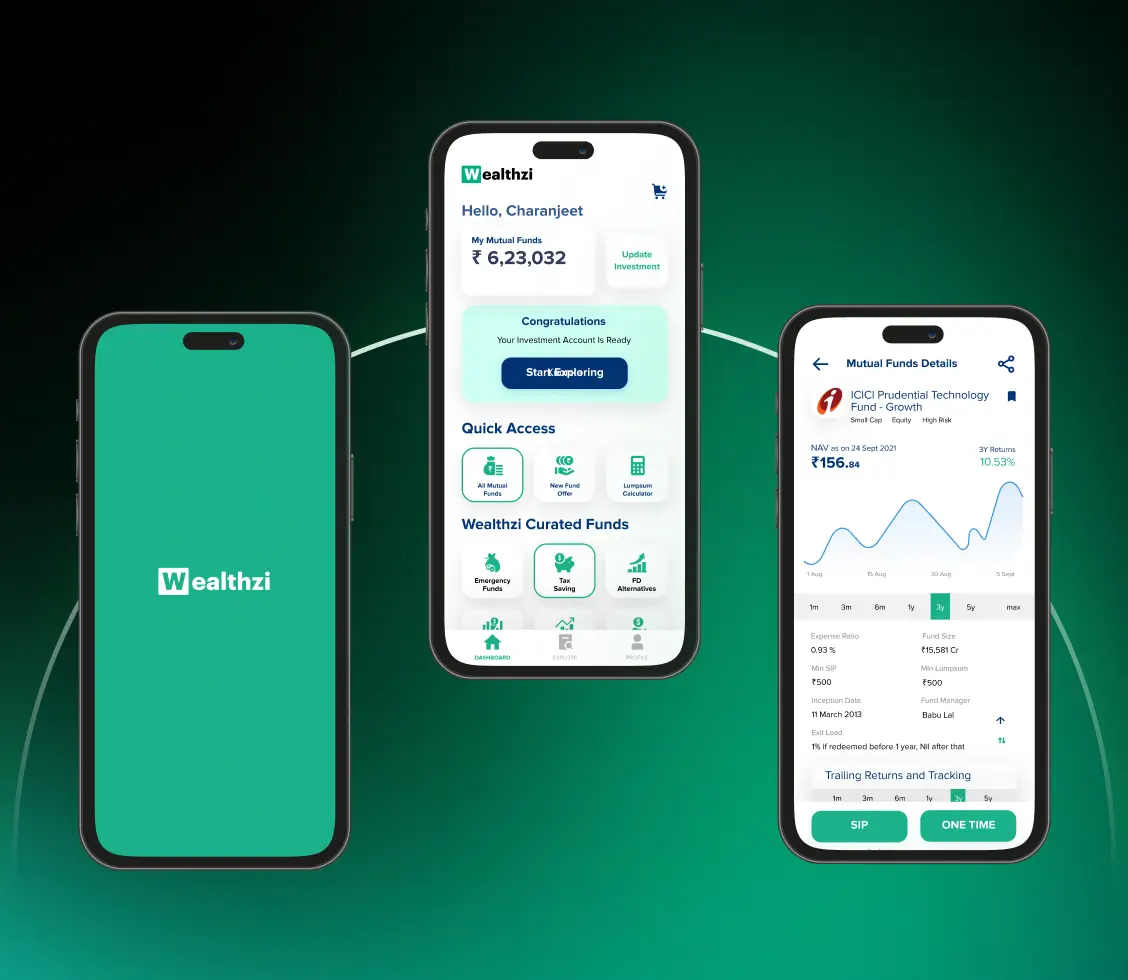
We built Wealthzi, a SEBI-compliant mobile and web platform offering zero-commission direct mutual fund investing, automated portfolio management, goal-based financial planning, AI-driven nudges for smarter decisions, seamless paperless KYC onboarding, and advisor tools for distributors to manage clients and grow their practice at scale.
Impact
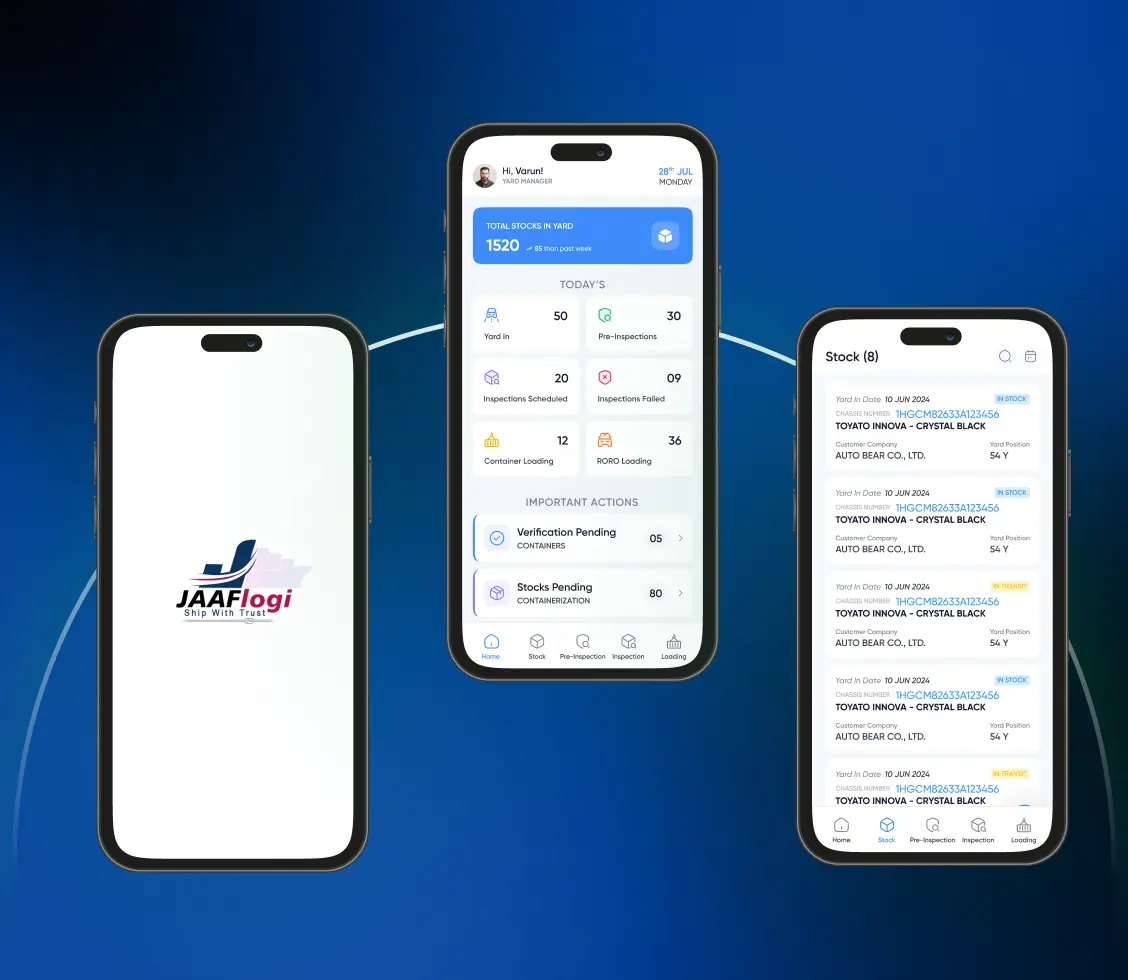
Vehicle Export Logistics APP — JAAFlogi
Challenge
Exporting used vehicles from Japan needs coordination across trucking, inspection, customs, and shipping, with manual processes causing delays and zero visibility for global buyers.
Solution
We built JAAFlogi, a web and mobile platform managing the vehicle export lifecycle end to end: stock, trucking, inspections, RORO shipping, customs, billing, real-time tracking, dedicated yard and driver apps, and a bilingual English/Japanese customer portal.
Impact

How We Build Your Marketplace
A sequence that starts with your supply rather than your feature list, because a marketplace with no sellers is a very expensive website, and that is the failure worth designing against.
Supply & Model Discovery
Who your first fifty sellers are, why they would join, and what your take rate has to be to work. This is also where we tell you if you are not ready and should prove demand another way first.
Vendor Model & Architecture
The decisions that are expensive to reverse: control boundaries between platform and seller, how commission is modelled, how an order splits, and how settlement will actually work with your gateway.

Platform & Seller Portal Build
Storefront, onboarding, seller portal and admin built in reviewable increments against a real seller's catalogue rather than demo data where every listing is tidy and every attribute is filled in.

Payments, Split Settlement & Tax
Gateway and split settlement wired and reconciled against real transactions, payouts proven end to end including the refund-after-payout case, and marketplace tax collection configured with your accountant present.

Pilot Cohort, UAT & Launch
A small cohort of real sellers onboards, lists and gets paid before anyone opens the doors. Their first payout is the genuine test, and the one that surfaces what the brief did not contain.

Supply Growth & Scale
Onboarding drop-off, seller retention and category coverage watched after launch, with the admin tooling rebuilt as the vendor count grows past what the first version was designed for.

Buy a Marketplace Product, or Build?
More enquiries fail this test than pass it, and we would rather say so before anyone scopes a build. Here is what we actually check.
When You Should Not Build Yet
No sellers waiting, and demand still unproven. A platform does not create supply and it does not create buyers. Selling on an established marketplace first, or running the category as a curated store where you hold the stock, tests the idea for a fraction of the cost. If that is where you are, do that, and come back when supply is chasing you.
When a Product Is Enough
A conventional commission model, a manageable seller count, standard payouts and no unusual rules. Hosted marketplace products and marketplace plugins genuinely cover this, and they will get you trading far sooner than we will. We will name them in discovery rather than pretend the category does not exist.
When Building Earns Its Cost
Four conditions, and one is usually enough: supply is already coming to you and the platform is the constraint; your commission, settlement or vendor rules are ones no product will express; per-transaction costs have outgrown a build at your volume; or the seller relationship and its data are the asset you cannot afford to rent.
What Building Actually Costs
More than the platform, because the ongoing work is seller support, moderation, dispute handling and supply acquisition, none of which the software removes. It earns its cost when the constraint is genuinely the platform. Built before that, it is a well-engineered empty room, and we would rather tell you than build it.
Marketplace Models We Build
The model changes the settlement, the trust mechanics and the unit economics
 Horizontal Retail Marketplace
- Niche & Vertical Marketplace
 Service & Gig Marketplace
 Rental & Booking Marketplace
 C2C & Resale Marketplace
 Marketplace Mobile Apps
Who We Build Marketplaces For
Every one of these already has supply, or a credible reason sellers will come. That is the qualifier, and it matters far more than the category they operate in.

Retailers Opening to Third-Party Sellers
An established store adding other people's stock to widen the range without buying it. The best starting position there is, because the buyers already exist and the first sellers are usually suppliers you know.
Niche & Vertical Operators
A category the horizontal platforms serve badly, where the attributes, the buying process or the trust requirements are specific enough that a general marketplace cannot represent them properly. Depth is the moat here, not scale.
Service & Gig Platforms
Where the listing is someone's time rather than an item, so availability, quoting and completion replace stock and shipping. Payment usually holds until the work is done, which makes escrow-style settlement and dispute handling central rather than optional.
Rental & Booking Marketplaces
Where the same item is sold repeatedly across time, so the model is availability calendars, deposits, damage handling and return condition rather than inventory counts. A genuinely different data model from retail, and one products rarely handle well.
Distributor & Dealer Networks
A brand opening a platform to its own dealers, where the sellers are contractually bound rather than openly recruited. Where the buyers are businesses with negotiated pricing and credit terms, that is our B2B marketplace build instead.
Marketplaces on a Product They Outgrew
Already trading on a hosted marketplace product or a plugin, with real sellers and real volume, now blocked by commission rules or settlement behaviour it will not bend to. Moving an existing platform is our migration and replatforming work.
Money, Trust & Compliance
The half of a marketplace nobody demos: what was collected, who it is owed to, who is allowed to sell, and who keeps the relationship. Where a deeper review is warranted, our cybersecurity consulting team works alongside the build.

Split Settlement & Payouts
One buyer charge dividing correctly across several sellers, on a schedule they can predict, with statements they can reconcile and correct handling when a refund follows a payout.

GST & Operator Tax Collection
Marketplace operators carry collection obligations a single-seller store does not. Built as configurable rules, with seller statements that reconcile, because the treatment is your CA's call.

Vendor KYC & Verification
Identity, business and bank verification captured once during onboarding and surfaced later where it influences a buyer, rather than collected and filed away unused.

Disputes, Returns & Refunds
A workflow with evidence, a decision path and an owner, plus the money movement that follows a decision, so a bad outcome is resolved rather than merely recorded.

Payment Security & Fraud
Tokenised handling through your gateway so raw card data never reaches your servers, plus the seller-side fraud controls a platform needs and a single-seller store does not.

You Own the Platform
Seller relationships, buyer records and commission history sit on your infrastructure and the code is handed over. On a marketplace the network is the asset, and it should not be rented.
Why Marketplace Operators Choose Webority
What a founder weighs before committing to a build that only pays off if sellers show up and stay.
Built Under CMMI Level 5 & ISO 27001
A marketplace holds other people's bank details, other people's customers and other people's money in transit. An audited process and audited security controls are the minimum a seller should expect of the platform they trust.
We Build the Settlement, Not Just the Storefront
Commission rules, split settlement and payout reconciliation are where marketplaces actually lose sellers. We design those first, because a beautiful storefront over broken payouts loses supply within a quarter.
We Tell You When Not to Build
If supply is not there yet, a platform is a well-engineered empty room. We say so and lose the project, because the alternative is taking money for something we can already see will not work.
Onboarding Designed as a Funnel
Seller sign-up is measured at every step, because each one is a place to abandon and an abandoned seller rarely returns. That single discipline moves supply growth more than any buyer-facing feature.
Piloted With Real Sellers First
A small cohort onboards, lists and gets paid before you open the doors. Their first payout is the real test, and it always teaches something the specification did not contain.
Delhi NCR Delivery, Global Clients
Our engineering centre is in Delhi NCR and we build marketplaces for operators across India, the US, the UK and the Gulf, with overlap hours and a cost base that makes owning the platform viable.
Certificates and Compliances
At Webority Technologies, we take pride in our professional recognition and reputation as a trusted name for all your business solution needs. Rely on us for expert guidance and exceptional results.










Related Services & Capabilities
A marketplace sits inside a wider commerce business. These are the adjacent builds, designed to connect to it rather than overlap it.




What Our Clients Say
Real words from the founders, product owners, and CTOs who chose Webority




Frequently Asked Questions
Multi-vendor marketplace development is building a platform where independent sellers list and sell through one storefront while you operate the platform and take a commission. It is a different product from an online store, because you are running a two-sided business: a buyer experience on one side, a seller experience on the other, and between them the machinery that decides who gets paid what and when. The storefront is the visible part. The parts that determine whether it survives are vendor onboarding, order splitting across sellers, commission and settlement, and the dispute handling that keeps both sides willing to come back.
Start on an existing one if you can, and we will say so in discovery. The hard part of a marketplace is supply, not software: sellers will not join a platform with no buyers, and buyers will not come to a platform with no selection, and no amount of engineering solves that. Selling on an established marketplace first, or running your category as a curated store where you hold the stock, proves demand far more cheaply than a platform build. Building earns its cost once supply is already coming to you, once commission on that volume outweighs what a hosted marketplace product costs, or once your commission, settlement or vendor rules are ones no packaged platform will express. If you do not yet have sellers waiting, a build is an expensive way to discover that.
It depends on scope, so we quote after discovery rather than from a price list. The drivers that actually move the number are how many vendor-facing surfaces you need and how much control sellers get over their own catalogue and pricing, how complex the commission model is, whether split settlement to many sellers is in scope and through which gateway, whether vendor KYC and verification are automated or manual, how search and discovery work across many catalogues, and the peak order rate the platform must survive. A curated marketplace with twenty invited sellers is a fraction of an open platform onboarding thousands. The comparison worth running is our fee against a hosted marketplace product plus its per-transaction cost over the years you intend to operate.
Commission is your business model, so it is built to your rules rather than a template. That usually means rates that differ by category, by seller tier or by negotiated agreement, with promotional and introductory periods, and it means the take rate is visible per order rather than reconstructed at month end. Payouts are the half that decides whether sellers stay: split settlement so each order divides correctly between you and the seller, payout schedules a seller can predict, statements they can reconcile against their own records, and correct handling when a refund lands after a payout has already gone out. Late or unexplainable payouts lose sellers faster than any missing feature.
Yes, and this is a genuine difference between operating a marketplace and running a store. A marketplace operator in India has collection obligations on behalf of its sellers that a single-seller store does not, alongside the usual place-of-supply and invoicing rules, and sellers need statements that reconcile with what was collected against their supplies. We build the platform to compute, capture and report all of it, with the rules configurable because rates, thresholds and treatment change and the treatment is your chartered accountant's call rather than ours. Reporting is designed so both you and your sellers can file from it rather than rebuilding it in a spreadsheet.
Onboarding is where marketplaces leak sellers, so it is built as a funnel rather than a form: staged sign-up, document and bank-account collection, verification, catalogue setup with bulk import, and a first-listing path short enough that a seller finishes it. Trust is the other half and it is continuous, not a gate at the start: verification status visible to buyers, ratings and reviews that resist manipulation, seller performance tracking against fulfilment and cancellation, and a dispute and returns workflow with a clear decision path. A marketplace with weak trust mechanics degrades quietly, because the good sellers leave first.
It can, and the scaling problems are not the ones people expect. Serving many catalogues is largely a search and indexing problem rather than a raw traffic one, because relevance across thousands of independently-maintained listings is harder than serving the pages. Settlement volume grows with sellers rather than with orders and becomes its own workload. Admin tooling that worked for fifty sellers becomes unusable at five thousand, which is an interface problem rather than an infrastructure one. We design for the vendor count you are actually heading toward, and we load-test against your real peak rather than an average, because a marketplace is judged on its sale days.
By who sells. If you sell your own products, that is an ecommerce platform and it belongs on our ecommerce solutions hub. This page is for when other sellers list alongside you and you take a commission, which makes vendor onboarding, split settlement and dispute handling the actual product. If your buyers are businesses with negotiated pricing, credit terms and bulk ordering, that is our B2B marketplace build instead. And if you are moving an existing store or marketplace between platforms rather than starting one, that is our ecommerce migration and replatforming work, which is a different project with different risks.