





























Ecommerce Migration & Replatforming Services for Live Stores
Webority moves trading stores between platforms without losing what they have already earned. Catalogue, customers and order history mapped deliberately rather than imported hopefully, every existing URL redirected from a plan written before the build, integrations re-pointed, and a cutover rehearsed in parallel with a rollback ready. Magento, Shopify, WooCommerce and legacy in-house stores, in any direction. Engineered under CMMI Level 5 and ISO 27001, from our Delhi NCR centre for clients across India, the US, the UK and the Gulf.
Get a Free Consultation
Fill in your details, and we will respond within 24 hoursTrusted by Leading Brands & Growing Startups









What Ecommerce Replatforming Actually Means
Building a new store is the easy half and the half everyone quotes on. The hard half is everything the old store has accumulated: a catalogue whose variants do not map cleanly onto the destination, customers whose passwords cannot travel, years of order history with refunds and partial fulfilments in it, thousands of URLs quietly earning rankings, and a set of integrations wired in by someone who has since left. Replatforming is moving all of that while the store keeps trading.
Most stores should not replatform. It is disruptive, it is rarely cheaper than the problem it is meant to solve, and a surprising share of migrations are triggered by a frustration that a fix on the current platform would have resolved. We would rather find that in an audit than three months into a project. This page is for the narrower case where the platform genuinely cannot go where the business is going.
Why Stores Actually Replatform
Six reasons that genuinely justify the disruption. Worth being precise about which one is yours, because the reason decides the destination, and a migration undertaken for a vague reason tends to arrive somewhere equally vague.





The Catalogue Outgrew the Data Model
Configurable products priced by dimension, bundles whose stock depends on components, made-to-order items with lead times, the same item sold in different units to different buyers. When the platform cannot express the product, a spreadsheet appears beside the store and someone keeps the two in agreement by hand. That is the clearest signal a platform has genuinely been outgrown rather than merely disliked.
Fees and the App Stack Crossed Over
A transaction percentage plus a dozen app subscriptions is excellent value at low volume and one of the larger lines in the accounts at high volume. Worth calculating properly rather than assuming, because the crossover is real but arrives later than most people expect, and a migration undertaken before it is an expense with no return attached.
Customisation Debt Has Frozen the Store
Years of plugins, patches and one-off changes, some by agencies no longer engaged, until nobody will touch the checkout because nobody is certain what depends on it. Updates get deferred, then deferred again. The store still works, and it has stopped being able to change, which for a commerce business is the same problem arriving more slowly.
The Platform Is Past End of Life
No security patches, extensions abandoned by their authors, hosting providers withdrawing support, and a payment gateway that will eventually decline to certify you. Magento 1 is the well-known case and it is not the only one. This is the one reason on this list that is a deadline rather than a judgement, and it is why those migrations are security-driven rather than commercial.
Performance Is Costing You Orders
A storefront that is slow on a mid-range phone on mobile data is losing orders before anyone sees the product, and it is being marked down in search at the same time. Sometimes this is genuinely the platform. Often it is a theme, an image pipeline and eleven tracking scripts, which is a fix rather than a migration, and an audit is what tells the two apart.
You Cannot Get Your Data Out Cleanly
The export gives you products but not the relationships between them, or orders without the refunds against them, or customer records with the history stripped out. Discovering the shape of that limitation during a migration is expensive; discovering it during an audit is merely inconvenient. For some businesses the inability to leave cleanly is itself the reason to leave.
What an Ecommerce Migration Actually Moves
Six workstreams that run in parallel, of which only one is the store your customers will see.
- 01 Catalogue & Product Data
- 02 Customers & Accounts
- 03 Orders & History
- 04 URLs, Content & SEO
- 05 Integrations & Payments
- 06 Storefront & Architecture





The Migration Engineering
Six disciplines that separate a migration from a relaunch that quietly lost a third of its traffic. None of them is visible in a demo, and every one of them is where real migrations fail.

Data Mapping First
How every product, variant, attribute and price rule translates into the destination model, decided and signed off before a line of migration code is written.

URL Map & 301 Plan
Every existing URL mapped to a destination up front, redirects generated from that map, and internal links rewritten to final targets rather than left hopping through chains.

Reconciled Dry Runs
Repeated migrations against a copy of your real data, with counts and totals reconciled after each pass, so cutover happens when the numbers match rather than when the calendar says so.

Integration Re-Pointing
ERP, warehouse, courier, gateway and marketplace connections rebuilt against the new platform and reconciled, including the ones whose API documentation is somebody's memory.

Parallel Run & Delta
Old and new running side by side with a final delta migration to catch orders placed during transition, and a cutover scheduled outside your peak rather than in the middle of it.

Rollback Before Launch
The reversal plan written before the launch plan, because a cutover you cannot undo is not a plan, it is a wager placed with your trading revenue.
Our Journey Of Making Great Things
Numbers that reflect over a decade of consistent delivery, trusted partnerships, and engineering excellence.
Years of experience
Projects delivered
Clients served
Countries reached
Our Success Stories
Every case study below is a product in production, built across healthcare, fintech, government, and e-commerce, and measured by the outcomes it delivers.
Field Inspection App - BRRF
Challenge
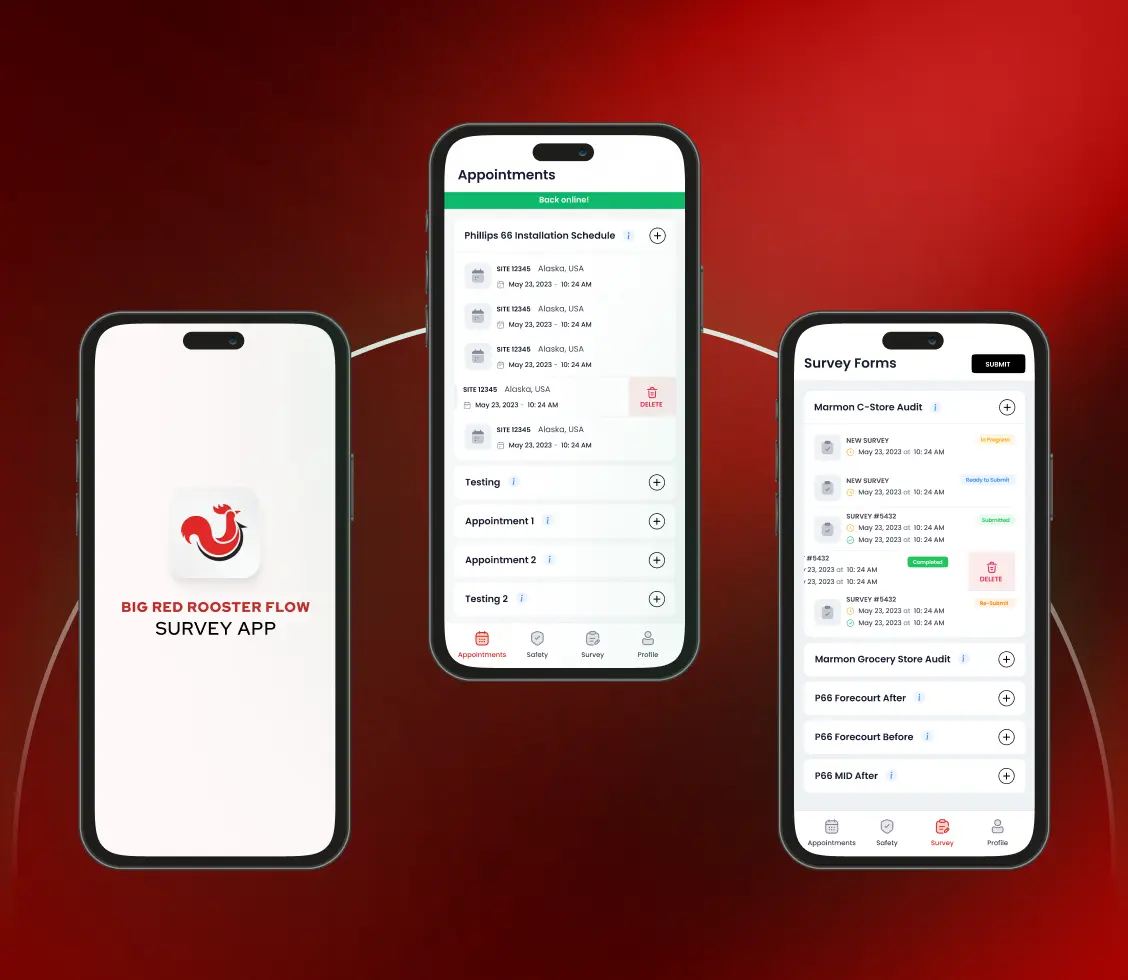
Big Red Rooster Flow's paper-based inspections across 500+ gas stations for Exxon, Marathon, 7-Eleven, Gulf, and BP suffered from 42% data error rates, 60-minute inspection times, and zero location verification, causing $4.2M in annual losses and threatening $18M in contracts.
Solution
We built a mobile-first survey platform with a no-code visual form builder, intelligent brand-specific survey logic, 99.3% accurate geofencing, full offline capability for 30+ days, a real-time operations dashboard with automated reporting, and role-based access for admins and field teams, deployed across 850+ field inspectors nationwide.
Impact
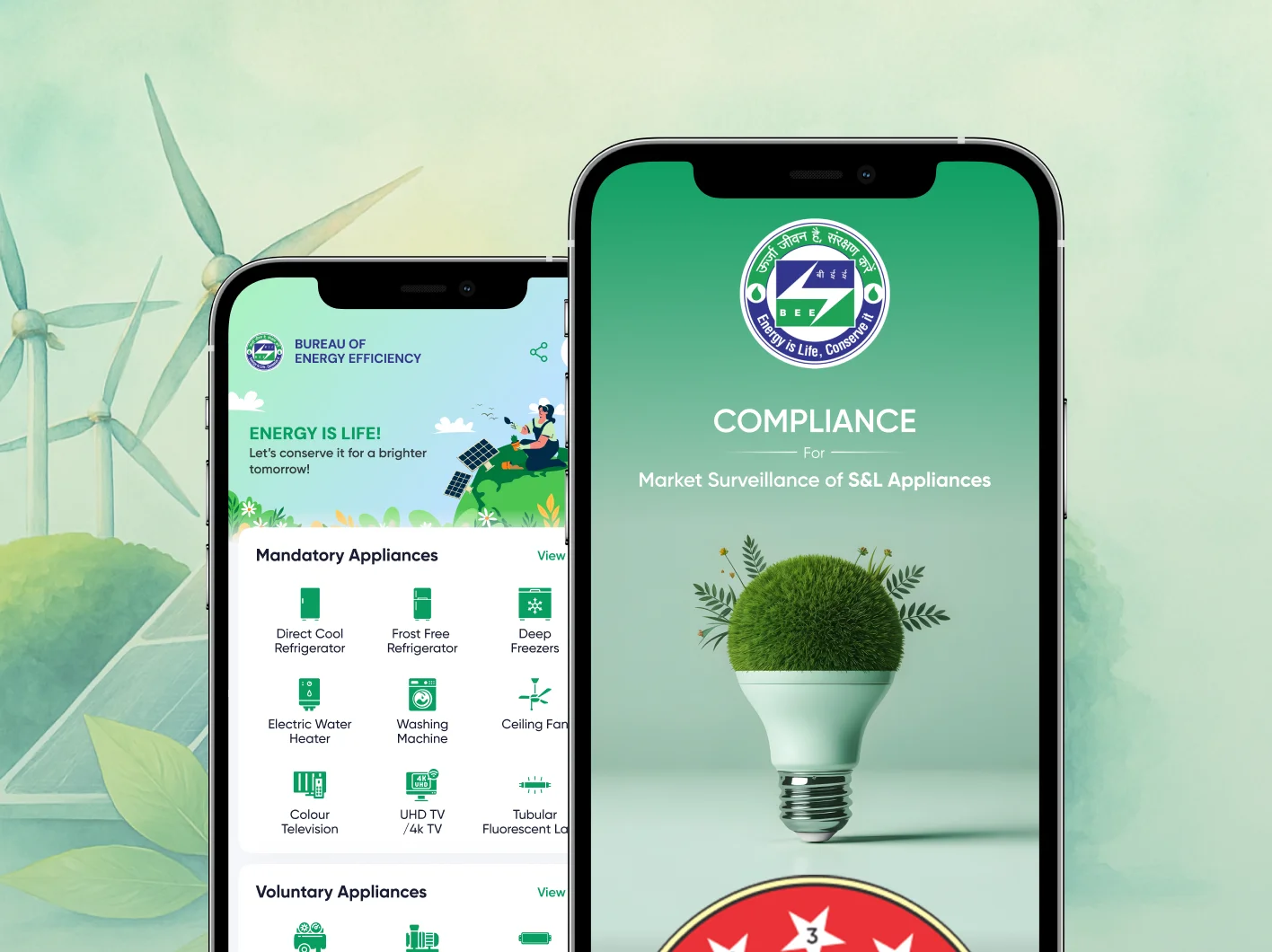
Energy Star Label Compliance App - BEE
Challenge
Manual inspection of Energy Star labels across India's vast appliance market was slow, error-prone, and lacked centralised visibility, making it difficult for BEE to enforce compliance or for consumers to verify appliance ratings.
Solution
We built a mobile and web platform that enables surveyors to validate star ratings, capture geo-tagged data with photo evidence, work offline, and generate instant reports, while giving consumers a simple interface to browse certified appliances, verify authenticity through star-label lookup, and raise complaints directly to BEE.
Impact

Cafeteria & Food Ordering App - Parliament of India
Challenge
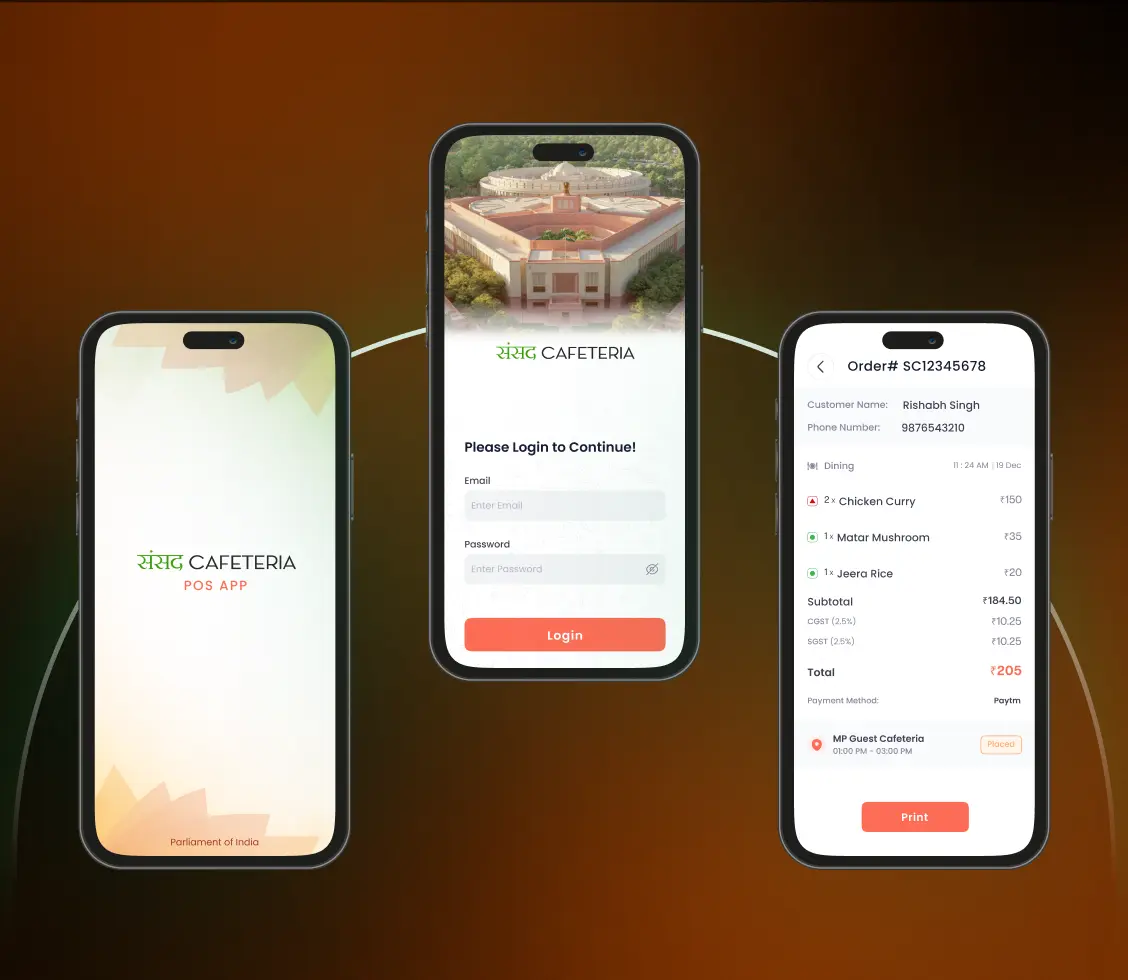
Food ordering within the Indian Parliament relied on traditional, manual processes, leading to long wait times, operational inefficiency, and logistical challenges in managing catering across a high-security environment.
Solution
We developed a mobile app for MPs and staff with real-time menu access, QR-based pickup, in-room delivery, integrated digital payments, and full order history, along with an admin portal for ITDC to manage live orders, menus, pricing, user roles, inventory, and reporting across Parliament canteen operations.
Impact
Mental Health Consultation & Booking App - Telepsych
Challenge
Fragmented booking systems and limited online options made accessing mental health consultations difficult for patients, while doctors and admins struggled with manual scheduling.
Solution
We built Telepsych, a web and mobile platform for booking online (Zoom) and in-person consultations, with secure payments, automated reminders, and session history, plus dedicated portals for doctors to manage availability and patient records, and for admins to oversee bookings, refunds, earnings reports, and daily clinic operations.
Impact

Online Ordering & Loyalty App - Foodme
Challenge
Restaurants lacked tailored digital tools for online ordering, payment processing, and customer engagement, limiting operational efficiency and scalable growth in an increasingly digital market.
Solution
We built custom mobile apps and websites with a central admin portal for menu and order management, Stripe-based secure payments, real-time order tracking, and built-in loyalty features including reward points, tiered memberships, personalised promotions, and push-notification campaigns to drive repeat customer engagement and retention.
Impact

Wealth Management & Direct Investing APP — Wealthzi
Challenge
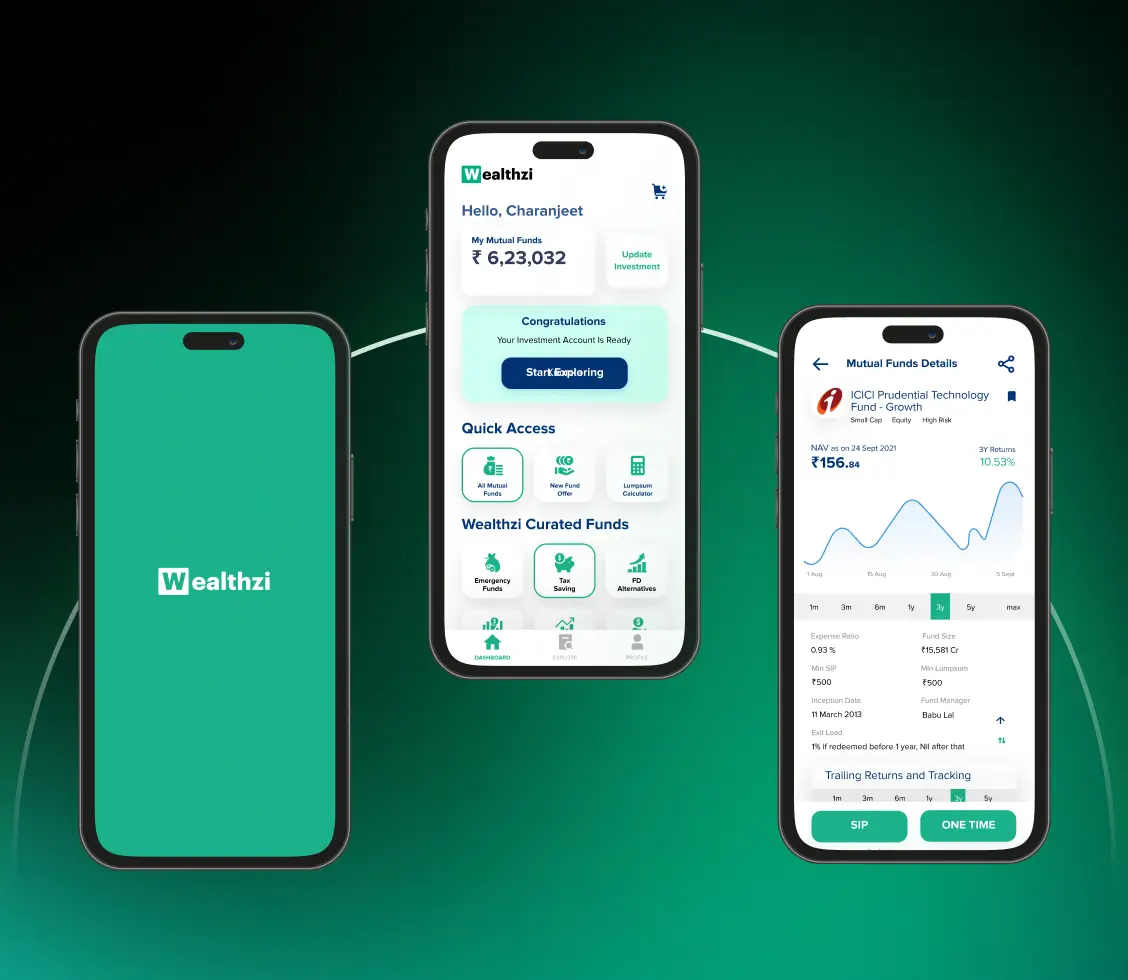
Indian investors lacked a unified, intelligent platform to manage diverse investments, relying on fragmented tools, manual advisory, and limited personalisation across mutual funds, PMS, and AIFs.
Solution
We built Wealthzi, a SEBI-compliant mobile and web platform offering zero-commission direct mutual fund investing, automated portfolio management, goal-based financial planning, AI-driven nudges for smarter decisions, seamless paperless KYC onboarding, and advisor tools for distributors to manage clients and grow their practice at scale.
Impact
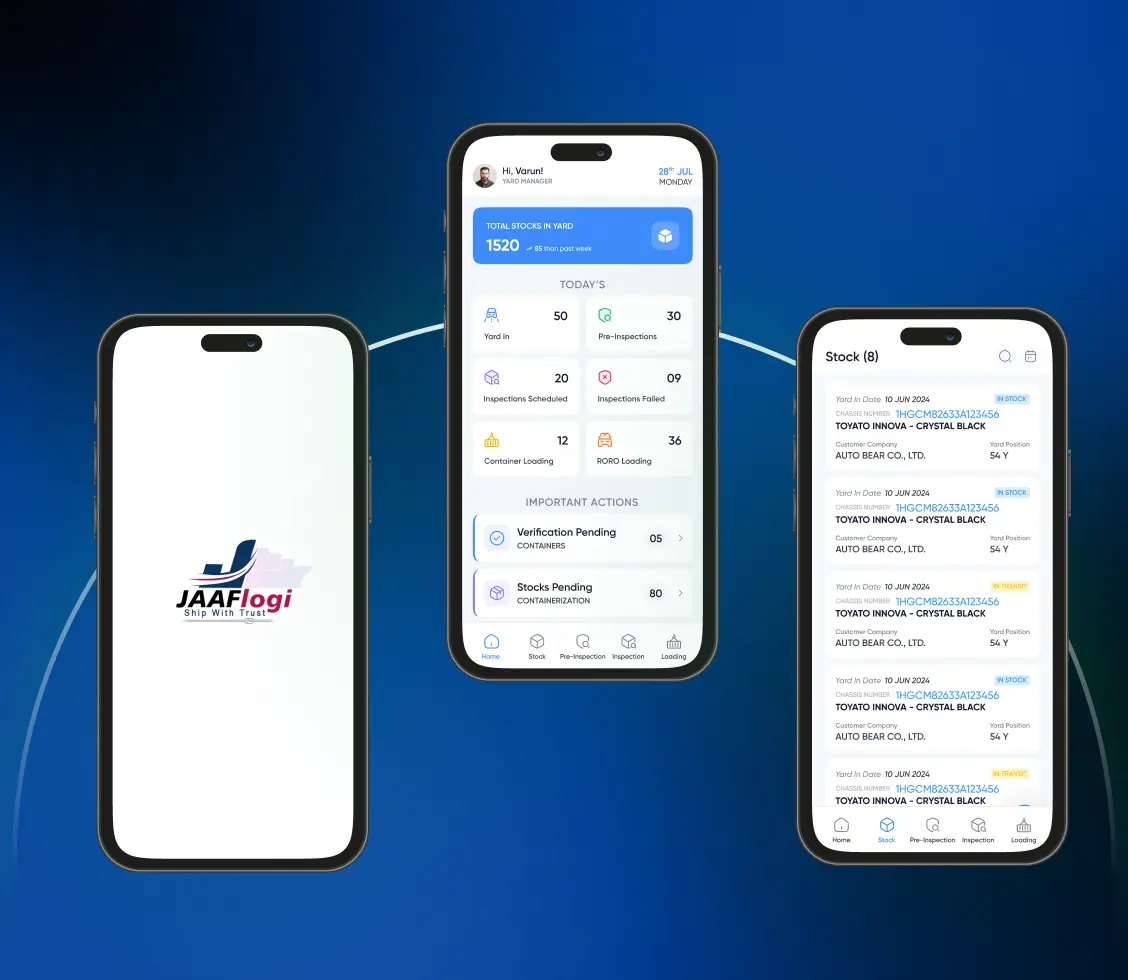
Vehicle Export Logistics APP — JAAFlogi
Challenge
Exporting used vehicles from Japan needs coordination across trucking, inspection, customs, and shipping, with manual processes causing delays and zero visibility for global buyers.
Solution
We built JAAFlogi, a web and mobile platform managing the vehicle export lifecycle end to end: stock, trucking, inspections, RORO shipping, customs, billing, real-time tracking, dedicated yard and driver apps, and a bilingual English/Japanese customer portal.
Impact

How We Run a Replatform
A sequence built around a store that is still taking orders. We audit before we recommend a destination, map before we build, rehearse before we cut over, and watch afterwards.
Platform Audit & Destination
We establish what actually broke, how much of it is the platform and how much is a theme, a plugin or a process. This is also where we tell you if a fix on your current platform is the better answer.
Data & URL Mapping
Catalogue, customer and order structures mapped into the destination model, and every existing URL mapped to where it will live. Both are agreed on paper before anything is built, because both are expensive to change later.

Build & Migration Dry Runs
The new storefront and back office built in reviewable increments, while the migration itself is run repeatedly against a copy of your real data and reconciled after every pass.

Integrations & Payments
ERP, warehouse, courier, gateway and marketplace connections rebuilt against the new platform and reconciled, with GST and settlement confirmed against real transactions rather than test ones.

Parallel Run, UAT & Cutover
Both stores live side by side, your team working real orders through the new one, then a final delta migration and a switch scheduled outside your peak, with the rollback already written.

Post-Launch Watch & Stabilise
Crawl errors, index coverage and rankings watched daily for the weeks that matter, alongside the performance tuning and small fixes that only real traffic reveals.

Stay, or Move?
A fair share of the migrations we are asked to quote should not happen, and we would rather establish that in an audit than discover it in month three. Here is the test we apply.
When You Should Stay
The platform still models your catalogue, the fees have not crossed over, and the frustration is a slow theme, a bloated plugin stack or a process nobody has revisited. Those are fixes, and they cost a fraction of a migration. We will tell you that and quote the smaller piece of work instead.
When You Should Move
Six conditions, and one is usually enough: the data model cannot express your products; fees and apps have genuinely crossed over; customisation debt has frozen the store; the platform is past end of life; the front end cannot be changed without fighting it; or you cannot extract your own data cleanly. Notice these are structural, not preferences.
What a Migration Really Costs
More than the build, because the expensive parts are the ones nobody quotes: data mapping decisions, integrations that depend on other people's APIs, the parallel run, and your own team's time in testing. Add the risk of a traffic dip if the URL work is treated as a final checklist item. It earns its cost when a structural condition above is genuinely true.
We Are Not a Platform Reseller
We hold no partner commission on the destination, so the recommendation is not shaped by which platform pays us. Sometimes the answer is a hosted platform on better terms, sometimes a custom build, sometimes a headless front end over the commerce engine you already have, and sometimes it is to stay and fix what actually broke.
Migration Routes We Run
In both directions, and onto custom builds where no packaged platform fits
- Magento 1 & 2 Migration
- Magento to Shopify
- WooCommerce to Shopify
- Shopify to WooCommerce
 Legacy or In-House to Custom
 Headless & Composable Front Ends
Who We Replatform For
Every one of these is already trading, already has customers, and cannot afford to lose either during the move. That constraint is what separates a migration from a build.

Magento Stores Past End of Life
Running unsupported, with abandoned extensions and a hosting provider losing patience. These migrations have a deadline attached rather than a business case to argue, and the usual question is only which destination and how fast.
D2C Brands Leaving Hosted Plans
Grown well enough that the transaction percentage and the app subscriptions now read as a tax on success, and the theme has stopped matching the brand. Usually the clearest crossover arithmetic on this list, and the easiest to check honestly.
WooCommerce Stores Under Plugin Debt
Forty plugins deep, where updates are deferred because nobody is confident what will break, and performance has degraded by accumulation rather than by any single decision. Sometimes a consolidation, sometimes a genuine move.
Stores Hitting Platform Limits
Where the checkout cannot be changed, the pricing model cannot be expressed, or an integration the business needs is simply not exposed. The limit is the platform's design rather than its configuration, which is the one thing configuration cannot fix.
Multi-Store & Multi-Region Groups
Several storefronts, currencies, tax regimes and catalogues that partly overlap, consolidating onto one platform. The mapping work multiplies here, and so does the value of getting it agreed before anyone builds.
Enterprises on Legacy In-House Builds
A store built in-house years ago by people who have moved on, still load-bearing, increasingly undocumented. Here the migration is as much an archaeology exercise as an engineering one, and the audit is the majority of the risk.
Why Stores Choose Webority to Move Them
What an owner weighs before letting anyone touch a store that is taking orders this morning and cannot afford a bad week.
Built Under CMMI Level 5 & ISO 27001
Migrations touch customer records, order history and payment configuration at once. An audited process and audited security controls are the minimum you should ask of anyone doing that to a live store.
Rankings Are a Workstream, Not a Checklist
URL mapping and redirect planning happen before the build, not after it. Treating them as a final task is the single most common way a technically clean migration loses a third of its organic traffic.
We Audit Before We Recommend
A fair share of migrations should not happen, and we would rather establish that in an audit than in month three. If a fix on your current platform solves it, we quote the fix and lose the bigger project.
No Platform Commission, No Agenda
We hold no reseller partnership on the destination, so nothing about the recommendation is shaped by which platform would pay us for it. That is worth checking of anyone advising you on a move.
The Store Keeps Trading
Parallel running, a final delta migration for orders placed mid-transition, cutover outside your peak, and a rollback written before the launch plan. Your revenue does not pause for our project.
Delhi NCR Delivery, Global Clients
Our engineering centre is in Delhi NCR and we replatform stores across India, the US, the UK and the Gulf, with overlap hours for the cutover window and a cost base that makes the work viable.
Certificates and Compliances
At Webority Technologies, we take pride in our professional recognition and reputation as a trusted name for all your business solution needs. Rely on us for expert guidance and exceptional results.










Related Services & Capabilities
A migration is one moment in a commerce business. These are the adjacent builds, designed to connect to it rather than overlap it.





What Our Clients Say
Real words from the founders, product owners, and CTOs who chose Webority




Frequently Asked Questions
Ecommerce replatforming is moving a live store from one platform to another, together with everything the store has accumulated: the product catalogue, customer accounts, order history, content, URLs and the integrations wired into it. It is not a rebuild with a copy-paste at the end. The build is the visible half; the half that decides whether it succeeds is data mapping, URL and redirect planning, and a cutover rehearsed enough that the store is not down and the rankings are not lost. Most stores should not replatform at all, and we will say so if that is what your situation calls for.
Not if the migration is planned around them, and this is the risk worth taking seriously because it is where replatforming projects most often lose money. Every existing URL is mapped to its destination before anything is built, 301 redirects are generated from that map rather than improvised at the end, titles, descriptions, structured data, canonicals and pagination behaviour are carried across, and internal links are rewritten to point at final destinations instead of hopping through redirects. After cutover we watch crawl errors, index coverage and rankings daily so anything that slips is caught in days. We engineer for no ranking loss and we will not promise it, because search results are not ours to guarantee and anyone who does is selling you something.
It depends far more on your data and integrations than on the platform you are moving to. The drivers are catalogue size and how cleanly products, variants and attributes map to the destination model, how much order and customer history moves with you, how many integrations have to be re-pointed and whether their APIs cooperate, how much custom functionality exists on the current store and whether it is still needed, and how much content and how many URLs are in scope. We scope it after a platform audit rather than quoting from a template, and we plan the cutover outside your peak trading period rather than during it.
That depends on what actually broke, and it is worth naming precisely before choosing a destination. If the constraint is transaction fees and an app stack, a hosted platform on better terms may solve it. If the constraint is a catalogue or pricing model the platform cannot express, a custom build is the honest answer. If it is performance or a front-end you cannot change, a headless or composable architecture over your existing commerce engine may be enough without a full migration. We are not a reseller for any platform, so the recommendation is not shaped by a partner commission, and sometimes the recommendation is to stay where you are and fix what is actually wrong.
Yes, and the honest part of that answer is that data is where migrations go wrong rather than where they go smoothly. Catalogue structures rarely map one to one, so variants, attributes, bundles and units of measure need deliberate mapping decisions rather than a default import. Customer passwords generally cannot be moved between platforms and need a reset flow designed so it does not read as a breach. Order history, refunds and partial fulfilments carry their own edge cases. We run repeated migration dry runs against a copy of your real data, reconcile counts and totals after each one, and only cut over when the numbers match.
In most cases the store keeps trading throughout and the switch is a DNS change at the end, with the old and new stores running in parallel beforehand and a final delta migration to catch orders placed during the transition. Whether that is genuinely zero downtime depends on your platform, your hosting and how payments and stock are handled at the moment of cutover, so we plan it against your specifics rather than claiming it as a feature. We also plan the rollback before we plan the launch, because a cutover you cannot reverse is a risk rather than a plan.
Yes, in both directions and between them: Magento 1 and Magento 2 to Shopify or to a custom build, WooCommerce to Shopify, Shopify to WooCommerce or to your own platform, and legacy or in-house stores onto something maintainable. Magento 1 stores in particular are past end of life and running unsupported, which makes their migrations security-driven rather than merely commercial. The destination is chosen from what broke on the current platform, not from a list of platforms we prefer to sell.
Yes, and the difference is everything that already exists. A new store has no catalogue to map, no order history to preserve, no URLs earning rankings and no integrations to re-point, so it is a different project with different risks. If you are starting fresh rather than moving, that is our ecommerce website development work and it is covered on our ecommerce solutions hub. This page is specifically for a store that is already trading, already has customers, and cannot afford to lose either during the move.